Breaking the Mold:
Glasstress and the Art of Reinvention

By Gabriel Delgado
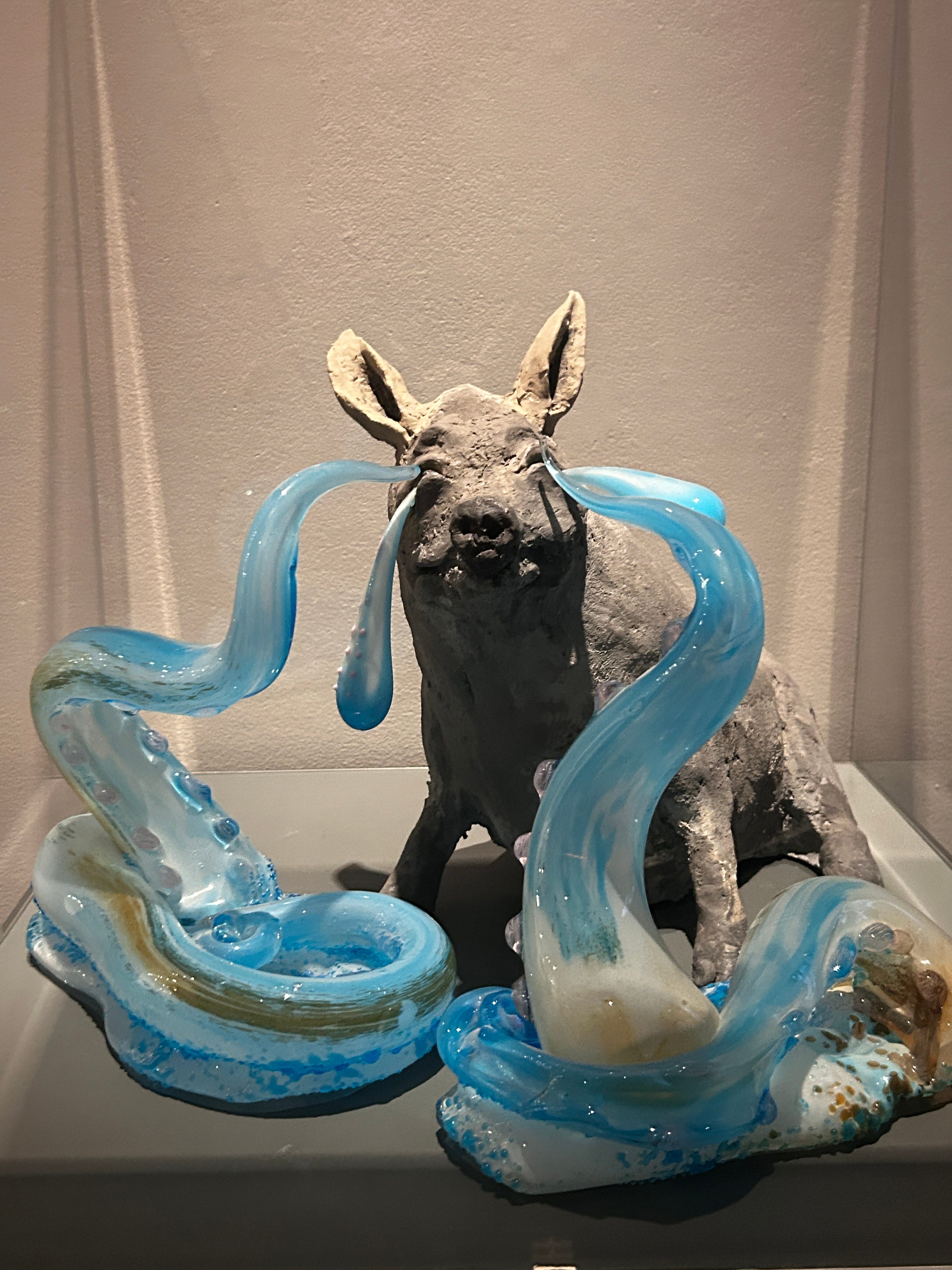
The exhibition Glasstress Boca Raton 2025 at the Boca Raton Museum of Art presents a sophisticated and multilayered exploration of glass as both a material and conceptual medium in contemporary art. This third iteration of the acclaimed series continues a vital collaboration with Berengo Studio in Murano, Italy, a site historically revered for its centuries-old glassmaking traditions. The project brings together internationally renowned contemporary artists, many of whom have never worked in glass before, to collaborate with Murano’s master artisans. The result is a dynamic fusion of contemporary vision and artisanal precision that reimagines glass not as a craft relegated to decorative objects but as a legitimate and powerful language within the contemporary art canon. A must see show for any art enthusiast in South Florida.
At its core, Glasstress invites artists to push the material boundaries of glassmaking while challenging the historical hierarchies that have long separated fine art from the applied arts.
A more outside the comfort zone studio pep talk to arrive at masterpieces.
This initiative does more than showcase technical mastery. It encourages critical discourse about the nature of collaboration, authorship, and material legitimacy in today’s global art landscape. (At a time when the global art market is soft, the switch to design and artisan mindsets are a refreshing breather). Each artwork becomes a site of experimentation, where artists introduce conceptual rigor and the Murano masters respond with technical ingenuity. This results in a redefinition of both process and outcome.
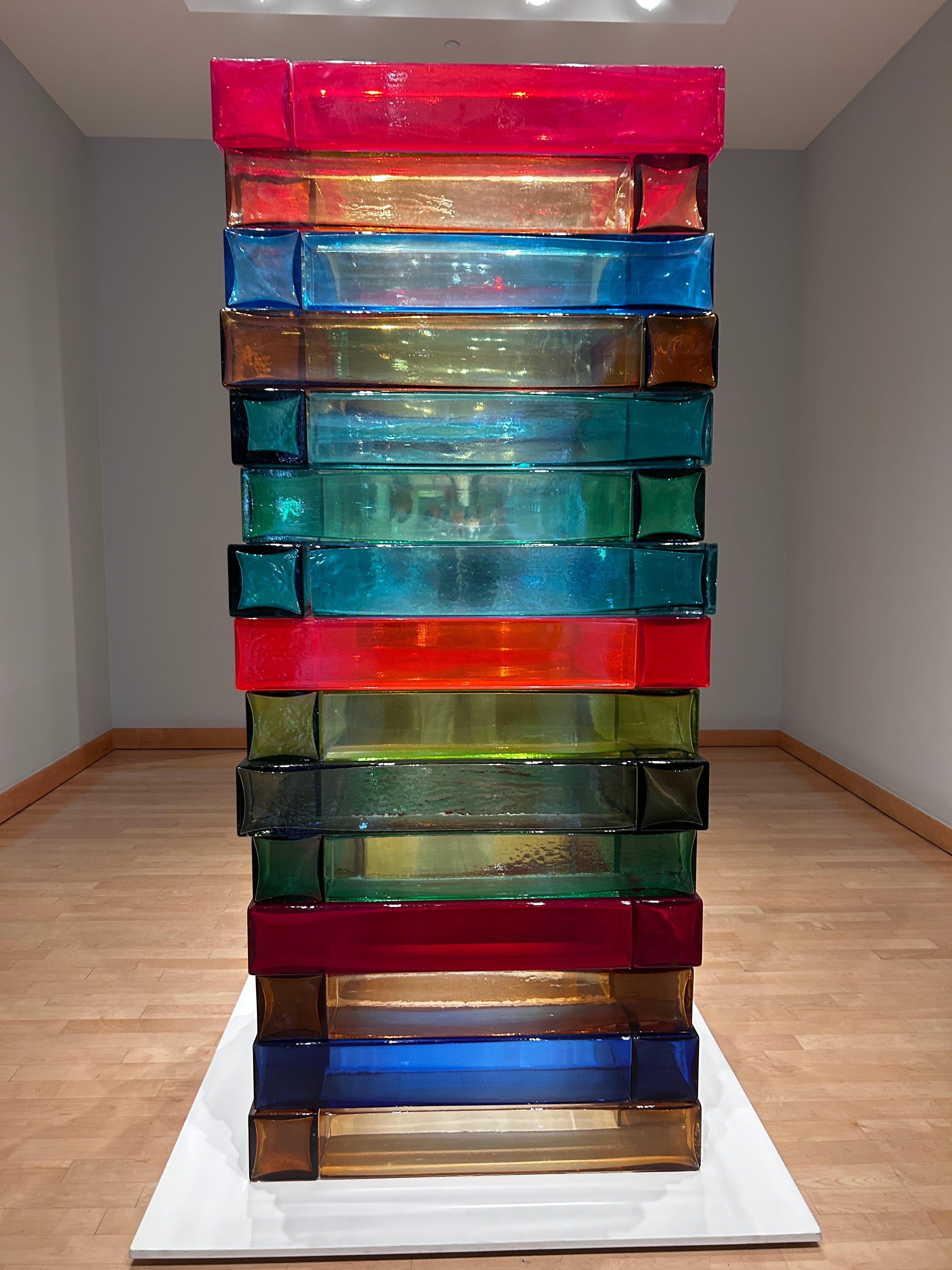
Among the featured artists, Irish painter Sean Scully exemplifies this alchemical exchange. Renowned for his luminous abstract canvases, Scully translates his visual language into sculptural form through Venice Stack, a nearly eight-foot-tall tower composed of handmade glass blocks. These chromatic modules, stacked with deliberate rhythm, recall the compositional density of his paintings while introducing new spatial and optical dimensions. The translucency of the medium allows color to behave not only on the surface but within the volume of the material itself, inviting contemplation of light, time, and gravity.
German artist Thomas Schütte contributes an installation of vividly colored glass urns, a motif that speaks to his ongoing interest in form, architecture, and mortality. His manipulation of traditional vessel forms resists nostalgic references and instead situates the urns within contemporary debates about monumentality, memory, and artistic legacy. The inclusion of Schütte, whose current retrospective is on view at the Museum of Modern Art in New York, anchors the exhibition within a broader institutional context and underscores the importance of this project in international contemporary art discourse.
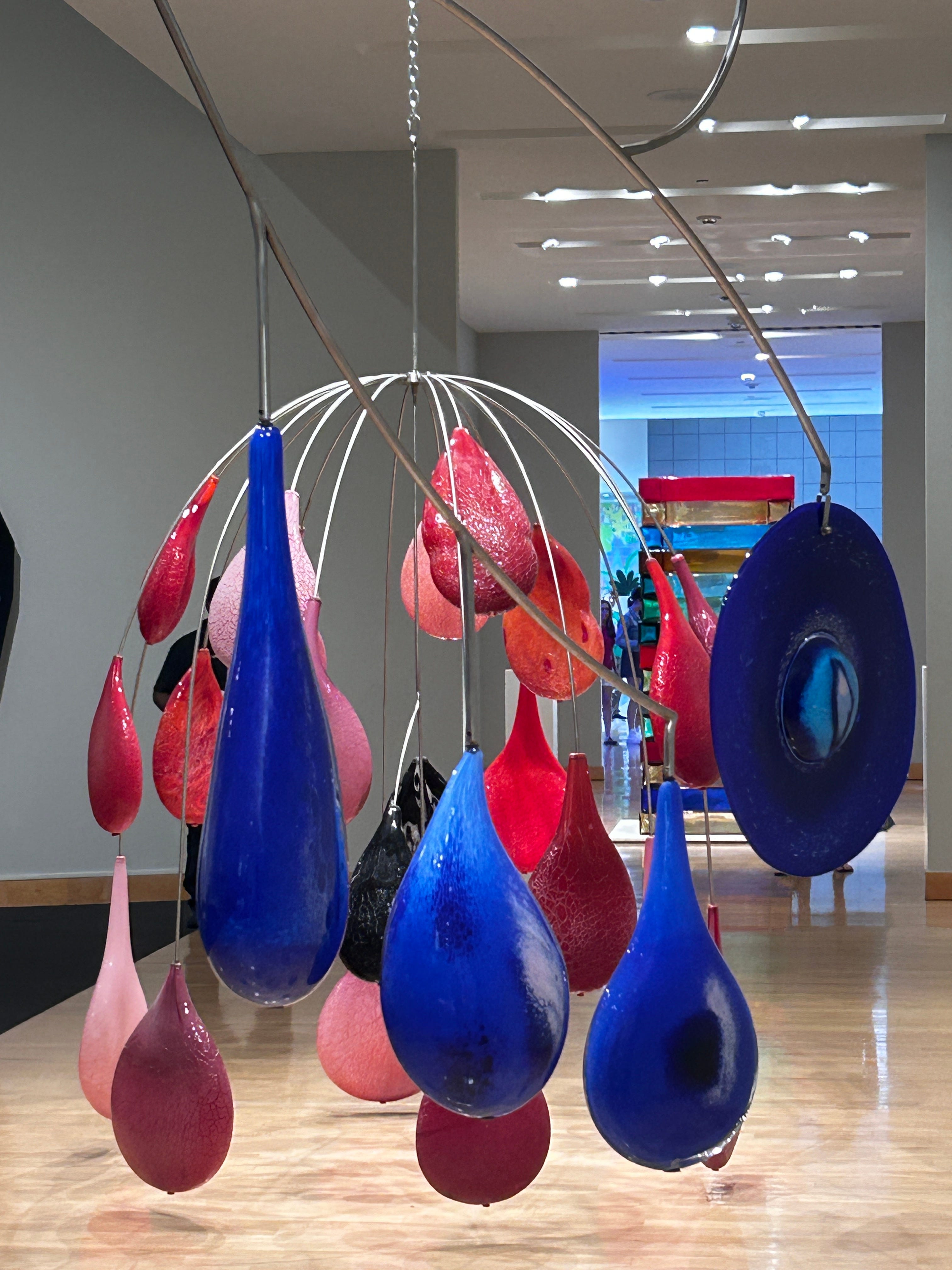
The exhibition is also deeply engaged with political memory and cultural resilience. Afro-Cuban artist and MacArthur Fellow María Magdalena Campos-Pons contributes a mobile installation of abstracted butterflies in honor of Breonna Taylor. The delicate yet haunting quality of the work merges poetic abstraction with social urgency. The butterflies, suspended in motion, suggest transformation, remembrance, and the ephemerality of justice. This offers a contemplative space within the broader context of racial violence and historical reckoning.
French artist Laure Prouvost, winner of the Turner Prize and celebrated for her immersive installations, brings a nature-focused work that continues her dialogue with organic forms, surreal imagery, and feminist narrative. Her sustained engagement with Murano’s glassmakers reveals a practice attuned to the sensory and the symbolic, where materials become extensions of lived experience and dream logic.
Russian-born artist Anna Jermolaewa, representing Austria in the 2024 Venice Biennale, contributes works shaped by geopolitical sensitivity and conceptual clarity. Her presence in the exhibition speaks to Glasstress’s relevance as a transnational platform that reflects a contemporary art world increasingly attentive to migration, identity, and sociopolitical rupture.
A highlight of this year’s edition is the specially commissioned work by Florida-based artist José Alvarez (D.O.P.A.), who presents Echoes of Silence in the Galactic Garden, his first sculpture in glass. Created in direct collaboration with Berengo Studio’s artisans, this mirrored work combines intricately rendered floral forms with iridescent surfaces and opulent gold accents. Alvarez, known for blending indigenous mythologies with psychedelic aesthetics, uses the reflective quality of glass to evoke a space of cosmic introspection and spiritual transcendence.
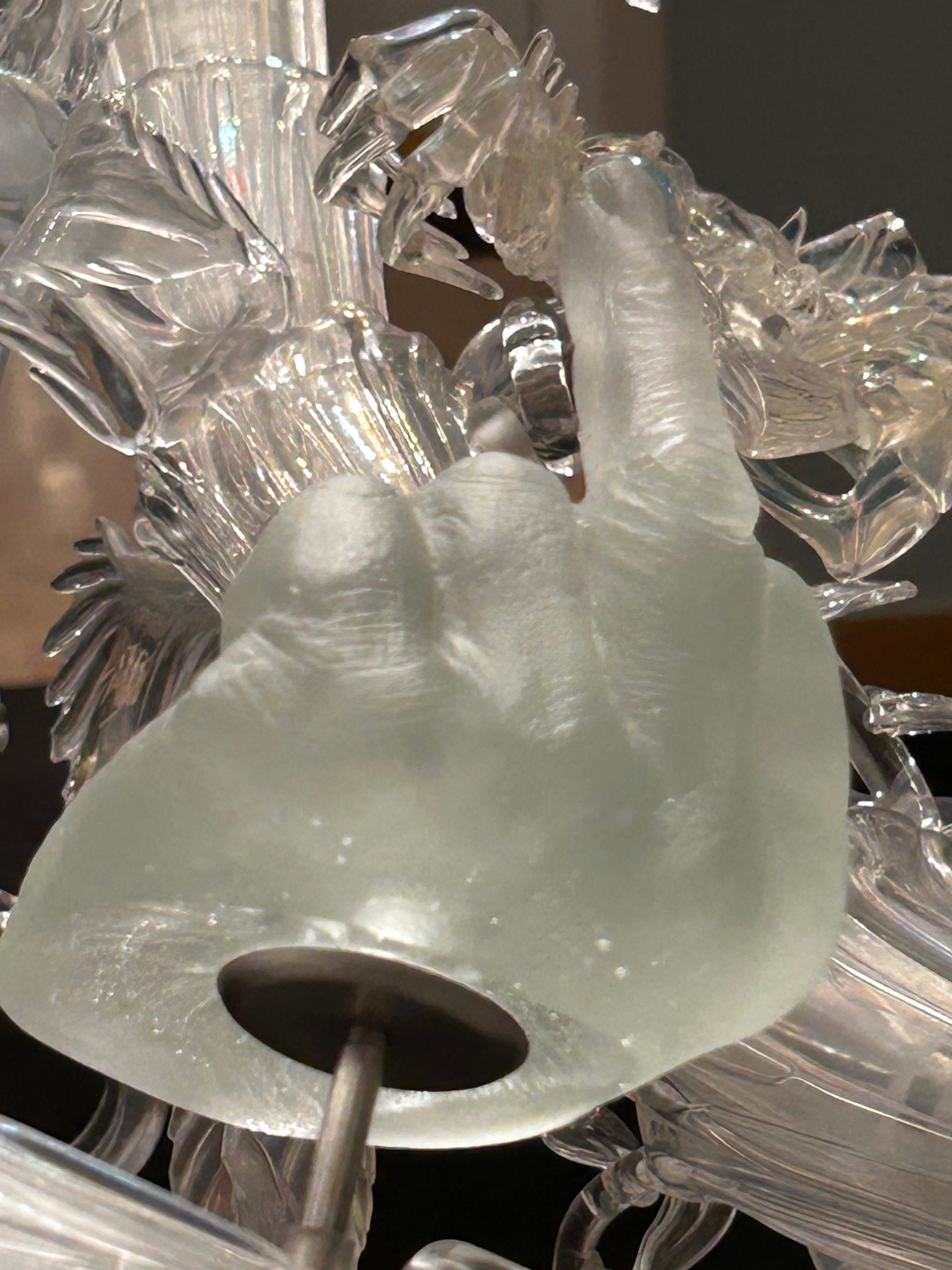
The exhibition also includes monumental contributions by global icons such as Ai Weiwei, whose chandelier sculpture interrogates spectacle and surveillance; Fiona Banner, whose life-size glass scaffold balances between structure and collapse; and Tony Cragg, whose organic abstractions underscore the fluid dynamism of sculptural form. Together, these works reveal the extraordinary range of glass as a medium and its capacity to contain contradiction, subtlety, and power.


Curated by Kathleen Goncharov, Glasstress Boca Raton 2025 is accompanied by a richly illustrated catalog that documents the process, evolution, and conceptual foundations of the works on view. This exhibition does not merely assemble exceptional artworks. It stages a conversation about tradition and innovation, about the precarious relationship between permanence and fragility, and about the enduring relevance of material practices in the digital age.
In a cultural climate where virtual media increasingly dominate, this exhibition reaffirms the significance of tactile, handcrafted materials and the collaborative labor that sustains them.
Glasstress Boca Raton 2025 serves as a timely reminder that glass, like art itself, is not a static medium but one continuously reshaped by the demands, ideas, and urgencies of the present.
Now lets take a look into some highlights of the exhibition:
Koen Vanmechelen's Temptation Series: Classical Marble, Contemporary Irony
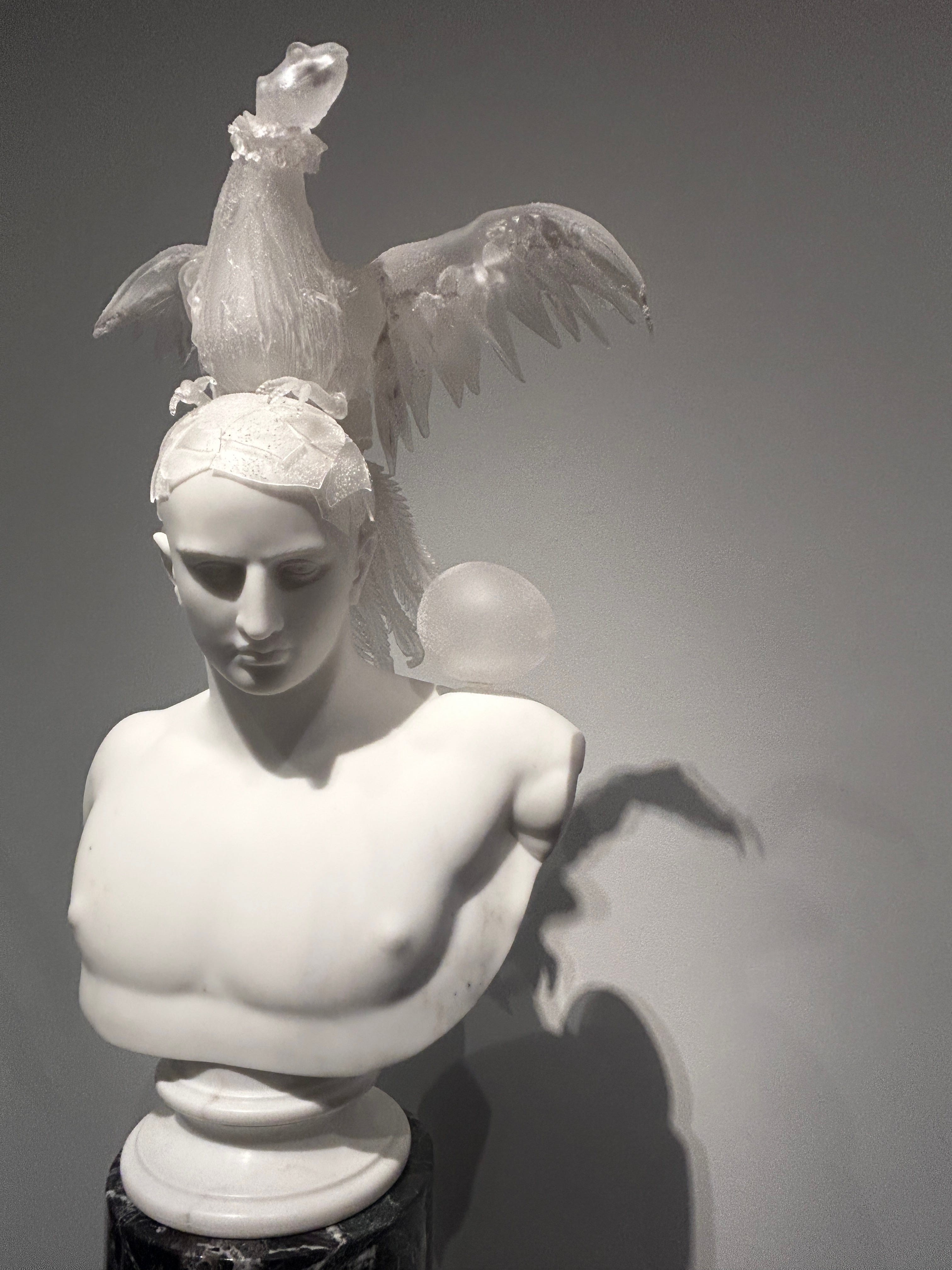
Koen Vanmechelen’s sculptural works Temptation: Constantinus, Temptation: Antinous, and Temptation: Alexander the Great present a compelling fusion of classical tradition and contemporary critique. These sculptures, composed of idealized marble busts topped with delicately formed glass animals, invite viewers into a multilayered dialogue that spans millennia. Vanmechelen, long engaged in themes of biological hybridity, cultural identity, and the evolution of power, uses this series to interrogate how myth, empire, and representation operate within both historical and contemporary frameworks.
Each bust is modeled in the classical style, invoking the aesthetics of Roman imperial portraiture and the refined neoclassicism of the Renaissance. The white marble surfaces recall the precision of Michelangelo’s carvings and the quiet authority of Canova’s neoclassical forms. The figures possess the solemn grandeur associated with antiquity. Their features are serene, their drapery skillfully rendered, and their posture imbued with the gravity of historical greatness. However, these associations are immediately disrupted by the fantastical glass forms perched atop their heads.


In Temptation: Constantinus, the dignified figure of the Roman emperor is crowned with a pair of elongated, swan-like glass necks that extend upward and outward. These forms resemble both birds and surreal balloon creatures, offering an intentional absurdity that undermines the sculpture’s original gravitas. The frosted, semi-translucent texture of the glass introduces a dreamlike quality, and the delicate rendering stands in contrast to the solidity of the marble.
Temptation: Antinous continues this visual contradiction. Antinous, celebrated in antiquity as a symbol of ideal male beauty and the beloved of Emperor Hadrian, is rendered in contemplative repose. Above him rises a glass bird with uplifted wings, accompanied by a hovering glass orb that resembles a fragile egg. The piece walks a fine line between reverence and parody, evoking themes of fertility, rebirth, and theatrical excess.
Temptation: Alexander the Great similarly juxtaposes the historical with the absurd. The legendary military leader and cultural icon is adorned with an elaborate headdress of glass that appears as both ornament and satire. Rather than presenting Alexander in his typical guise of lion-like strength, Vanmechelen offers a softer, almost playful reinterpretation, using animalistic and vegetal motifs that suggest the porous boundary between myth and invention.
Seen through an art historical lens, these sculptures function as interventions into the Western tradition of monumental portraiture. Classical marble busts have long served as symbols of power, intellect, and legacy. They are designed to communicate permanence and authority. Vanmechelen engages this legacy by upholding the craftsmanship and iconography of antiquity while simultaneously challenging its cultural assumptions. The addition of the glass animals creates a rupture in the narrative of heroic idealism, offering instead a humorous, critical, and speculative reimagining.
The choice of materials is central to the conceptual impact of these works. Marble has traditionally signified durability, timelessness, and virtue. It is often associated with the divine and the eternal. In contrast, glass is fragile, ephemeral, and performative. Murano glass in particular carries connotations of luxury, delicacy, and spectacle. By uniting these two materials, Vanmechelen foregrounds the tension between solidity and fragility, history and play, permanence and impermanence.
The visual vocabulary of the glass forms also recalls contemporary pop culture and postmodern parody. Their resemblance to balloon animals or carnival costumes suggests a playful mockery of traditional symbols of status and masculinity. This brings to mind the work of artists such as Jeff Koons and Maurizio Cattelan, who also blend classical aesthetics with elements of satire and excess. However, Vanmechelen’s critique is more nuanced. Rather than merely mocking history, he stages a confrontation with its structures, asking what it means to inherit, repeat, or reinvent the visual codes of power.
The title of the series, Temptation, introduces yet another layer of meaning. It calls attention to the seductive pull of myth and legacy, and to the allure of aesthetic perfection. At the same time, it suggests vulnerability, illusion, and desire. These sculptures do not simply commemorate historical figures. They question the very frameworks through which we understand heroism, authority, and cultural continuity.
Vanmechelen’s works exist within a broader contemporary practice in which artists repurpose classical forms to question the ideologies they once upheld. Yet his approach is neither dismissive nor ironic for its own sake. His sculptures are rich with symbolic resonance, technical mastery, and philosophical inquiry. They ask viewers to reconsider not only what they see, but how history is constructed, remembered, and reimagined.
Ultimately, the Temptation series offers more than just a visual or material juxtaposition. It proposes an ongoing negotiation between past and present, where artistic lineage is neither rejected nor blindly preserved, but continuously reinterpreted. These sculptures are both homage and critique, reverent and mischievous, grounded in art historical tradition yet pointedly attuned to the absurdities of the contemporary moment.
Ai Weiwei’s White Chandelier (2021): Baroque Excess and Political Defiance in Blown Glass
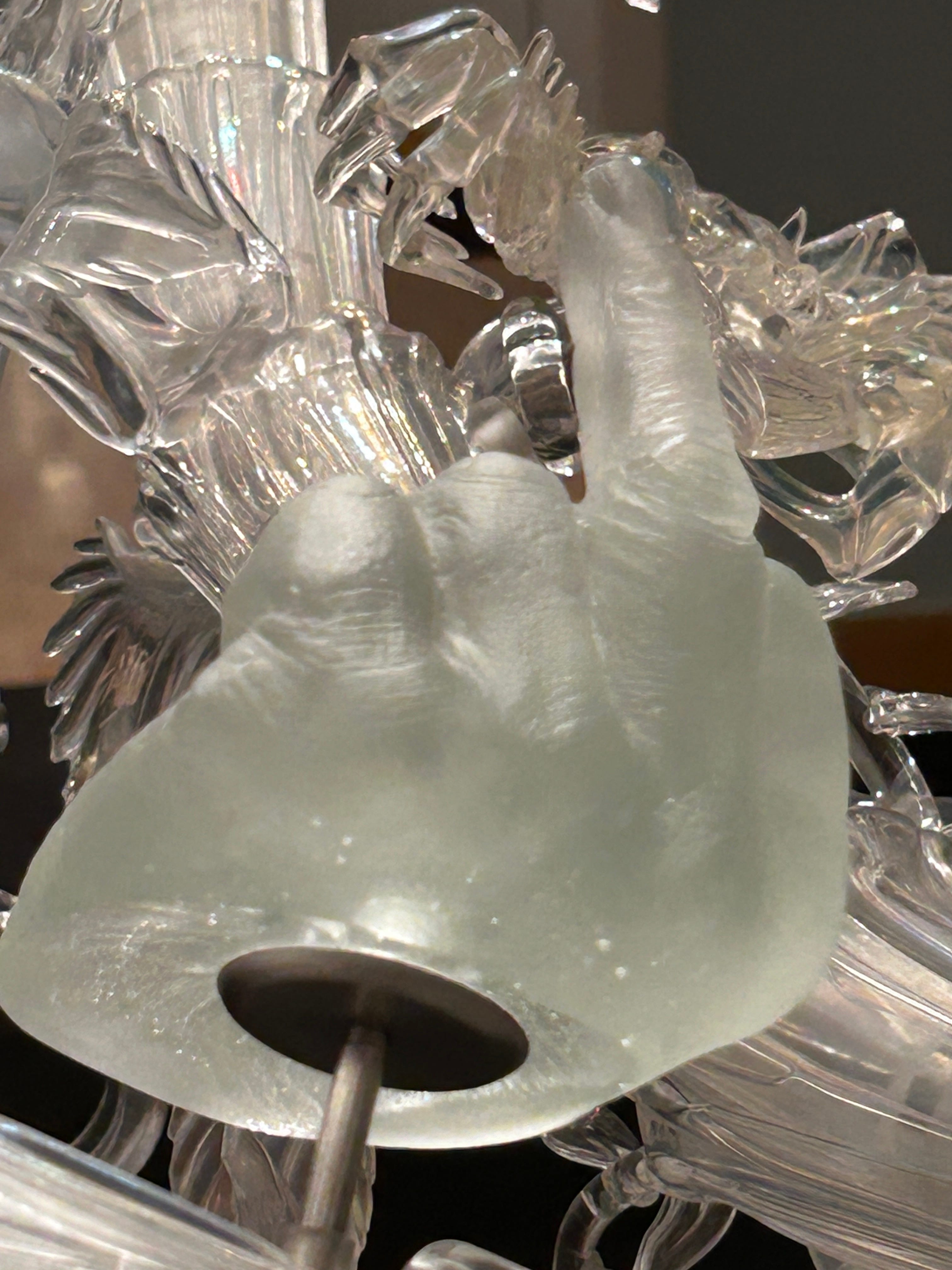
Ai Weiwei’s White Chandelier (2021) is an elaborate, large-scale sculpture made from blown glass and steel that reconfigures the historical legacy of the chandelier through a distinctly contemporary lens. Installed at the Boca Raton Museum of Art as part of the Glasstress exhibition, this work not only dazzles with Baroque grandeur but also bristles with subversive political meaning. Drawing from the traditions of 18th-century Venetian chandeliers, the artist transforms what is often perceived as a decorative object into a vehicle for resistance, critique, and personal testimony.
At first glance, White Chandelier seems to belong to the tradition of opulent lighting fixtures found in European palaces and salons. Its twisting vines, floral motifs, and transparent delicacy reflect the ornamental vocabulary of Murano glasswork. However, a closer look reveals elements that destabilize this historical aesthetic. Interwoven among the vines and blossoms are unsettling forms: a cast of a human hand raising its middle finger, pairs of handcuffs dangling incongruously, and clusters of small crabs moving through the foliage. These are not merely visual quirks but signifiers loaded with meaning.
The glass hand, with its unmistakable gesture of defiance, references Ai Weiwei’s own history of imprisonment and censorship by the Chinese government. It also echoes earlier works such as his Study of Perspective series, in which the artist photographs himself making the same gesture toward various global landmarks. Here, that act is embedded within a seemingly decorative object, transforming passive beauty into provocation. The handcuffs speak directly to Ai’s 2011 detention and the broader apparatus of state surveillance. By placing these within the structure of a chandelier, Ai juxtaposes the ornamental with the carceral, the refined with the repressive.
The crabs, often present in Ai’s previous work, carry a multilayered symbolism. In Mandarin, the word "he xie" is a homonym for both "river crab" and "harmony." The Chinese state employs the term "harmony" in its official discourse to mask acts of censorship and social control. On the internet, "crab" has become slang for this sanitized authoritarianism. In White Chandelier, the crabs nestle among the curling flowers and arabesques, undermining the idyllic surface with a quiet but incisive critique.
Materially, the chandelier operates in tension with its own fragility. Glass, while beautiful and light-responsive, is also brittle and easily broken. This contradiction becomes part of the work’s conceptual framework. The illusion of stability, grandeur, and tradition embodied in a chandelier becomes a metaphor for political systems that mask coercion beneath a veneer of cultural pride and continuity.
From an art historical perspective, Ai Weiwei’s work continues the legacy of Duchampian readymades and postmodern appropriation, but with a specificity grounded in autobiography and activism. The chandelier form, which historically signifies light, clarity, and enlightenment, is here transformed into a vehicle for irony and exposure. The object invites viewers to admire its craftsmanship while confronting the layered histories of control, resistance, and artistic voice.
Ai’s decision to use Murano-style blown glass also implicates the tradition of Venetian artisanship in this narrative. The collaboration with Murano’s glassmasters links the political urgency of the present with the inherited techniques of the past. It invites a reevaluation of what decorative arts can mean when placed in dialogue with contemporary struggles. The sculpture thus becomes both global and local, ancient in method and immediate in message.
White Chandelier stands as an exemplar of Ai Weiwei’s ability to transform aesthetics into a form of activism. It is visually seductive and intellectually confrontational, marrying the beauty of glass with the sharp edge of dissent. In doing so, it reclaims the chandelier from its historical associations of excess and power, and turns it into a luminous indictment of the very systems that attempt to silence artists and control narratives. It does not illuminate merely the gallery space but also the structures of oppression that persist beyond its walls.
Sean Scully’s Venice Stack (2020): Color, Mass, and the Monumental in Glass
Sean Scully’s Venice Stack (2020), on view at the Boca Raton Museum of Art, marks a pivotal evolution in the artist’s long career as a painter of abstract geometries. Best known for his compositions of color blocks and linear partitions on canvas, Scully here transfers his distinct painterly language into the sculptural realm through the material of hand-blown Murano glass. The result is a towering structure composed of vividly colored, hollow rectangular forms stacked vertically into a monumental column. While its structure is simple, the work is anything but reductive. Rather, it is a meditation on weight, color, light, and transformation.
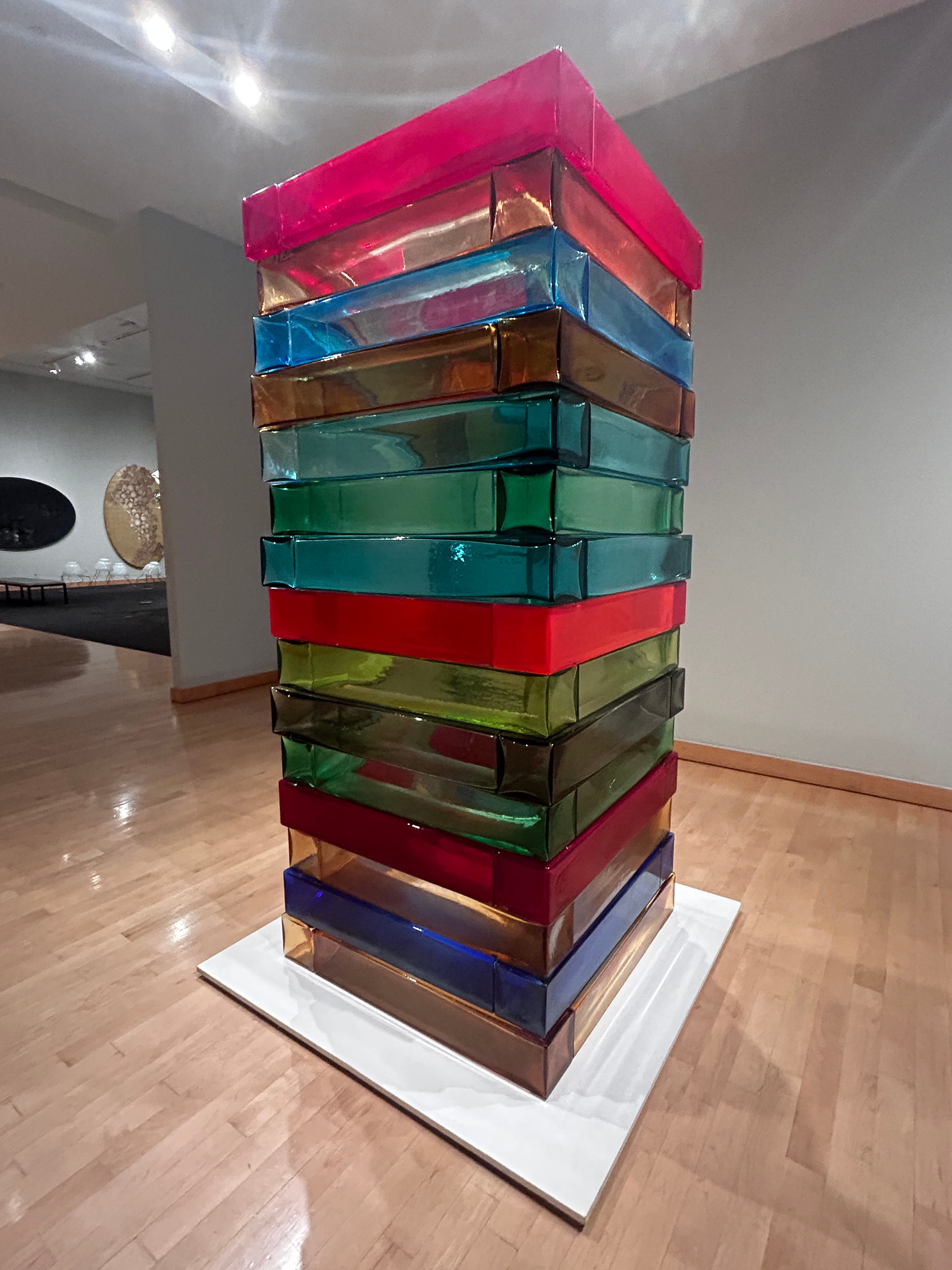
Scully has often spoken of his interest in materiality and the metaphysical resonance of form. In Venice Stack, these concerns are amplified by the unique properties of glass, a medium that allows light to penetrate, refract, and reflect within and across surfaces. Each unit in the sculpture reads as both solid and transparent, grounded and luminous. The internal luminosity of each block, achieved through subtle imperfections and air bubbles, introduces a sense of vitality that is not possible in paint alone. Color, here, is not applied but embodied.
The composition consists of sixteen glass blocks in alternating hues—ruby red, emerald green, cobalt blue, amber, and aquamarine—each echoing the chromatic intensity of Scully’s most iconic paintings. The stacked arrangement references minimalist sculpture, recalling the works of Donald Judd or Anne Truitt, but Scully’s stack is more sensual and expressive. The slight bowing of the forms, the irregular hand-molded edges, and the visible seams of air within the glass highlight the human hand behind the object, preserving a tactile immediacy that resists industrial repetition.
Scully’s decision to work with Murano glass also situates the piece within a specific historical and geographic context. Murano, a Venetian island synonymous with glassmaking excellence since the 13th century, represents both continuity and reinvention in the history of decorative arts. By collaborating with Murano artisans, Scully connects contemporary abstraction with an artisanal lineage rooted in pre-modern craft. This gesture bridges the conceptual austerity of postwar modernism with the sensory richness of material tradition.
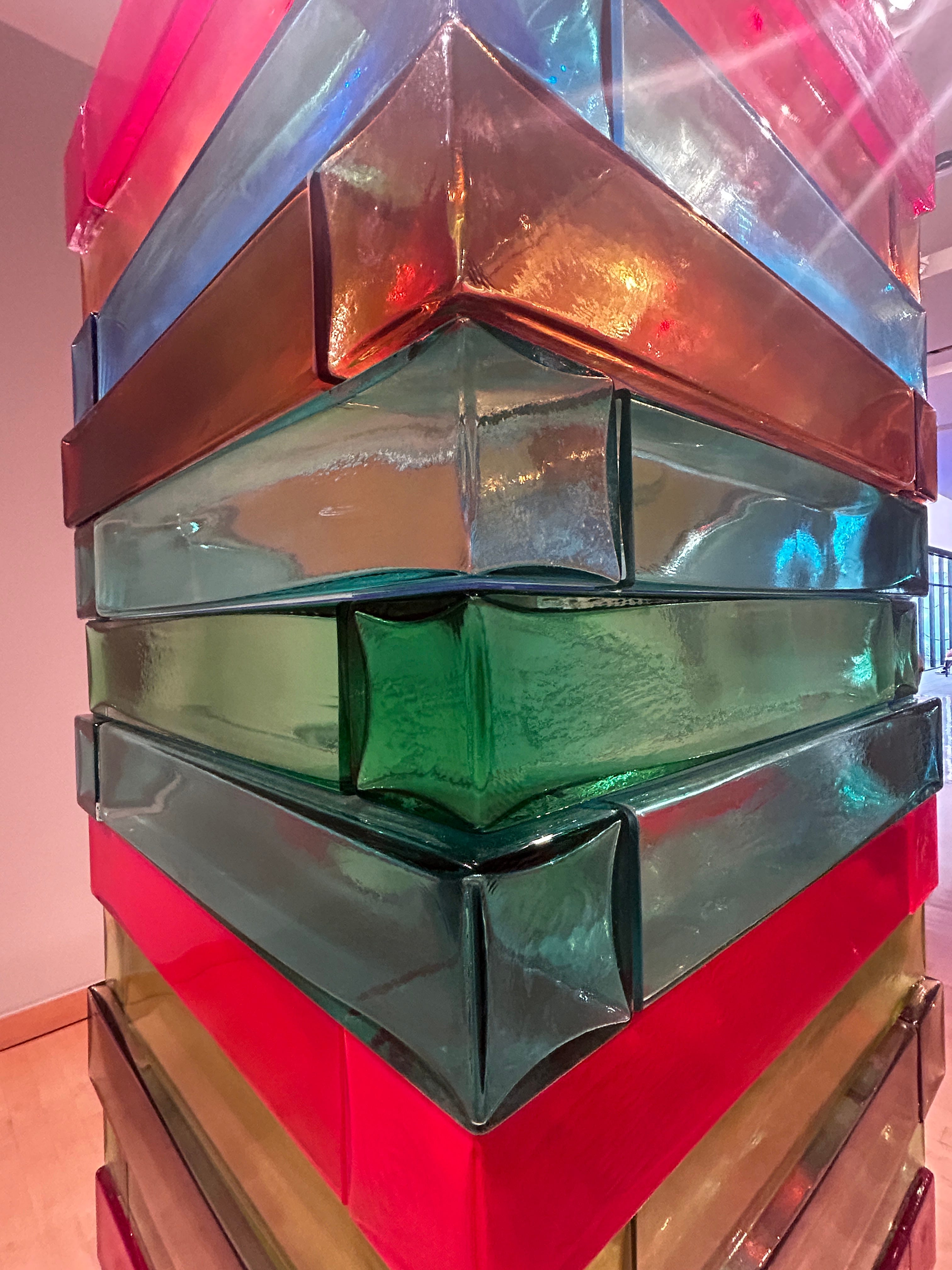
Venice Stack can be read as a sculptural counterpart to Scully’s earlier painted series Wall of Light, in which tessellated color fields suggest spiritual or architectural structures. In this glass work, the stack becomes a kind of chromatic totem, at once architectural and luminous. The work evokes religious relics, stained glass windows, and votive offerings, recontextualized within a minimalist framework. There is a tension between mass and lightness, between the gravity of the vertical form and the visual buoyancy created by its radiant hues.
This sculpture is also a scaled variation of his earlier installation Opulent Ascension, exhibited in the Basilica of San Giorgio Maggiore during the 2019 Venice Biennale. While that piece reached toward the ceiling of the basilica, echoing the vertical aspirations of spiritual architecture, Venice Stack offers a more intimate encounter with its human-scaled dimensions. Even so, it retains a monumental presence, radiating stillness, power, and meditative intensity.
From an art historical perspective, Venice Stack is a compelling intersection of traditions. It draws upon the logic of seriality and repetition that defined much of 20th-century abstraction, but it subverts that logic through material specificity and expressive variance. Its chromatic program recalls the works of Josef Albers or Mark Rothko, but instead of building optical experience through illusion, Scully constructs it physically, in glass, through accumulated layers of color and transparency.
Ultimately, Venice Stack affirms Sean Scully’s position as an artist deeply committed to the possibilities of abstraction beyond the painted surface. By embracing glass, he expands his formal vocabulary without abandoning the philosophical concerns that have long defined his work. The sculpture stands as a beacon—reflective, chromatic, and alive with light—inviting viewers into a contemplative relationship with space, color, and material presence.
In conclusion, Glasstress Boca Raton 2025 redefines glass as a powerful medium in contemporary art, shifting it from craft to concept. Through bold collaborations between global artists and Murano glassmasters, the exhibition explores themes of identity, memory, politics, and tradition with striking clarity and material ingenuity.
Each work embodies a dynamic fusion of artistry and meaning in an exhibition that reminds us that in an increasingly digital world, the handmade and the fragile still hold deep relevance, inviting us to see glass, and art itself, as ever-evolving, reflective, and resonant.
For more information, visit:
https://bocamuseum.org/art-experience/exhibitions/glasstress-boca-raton-2025